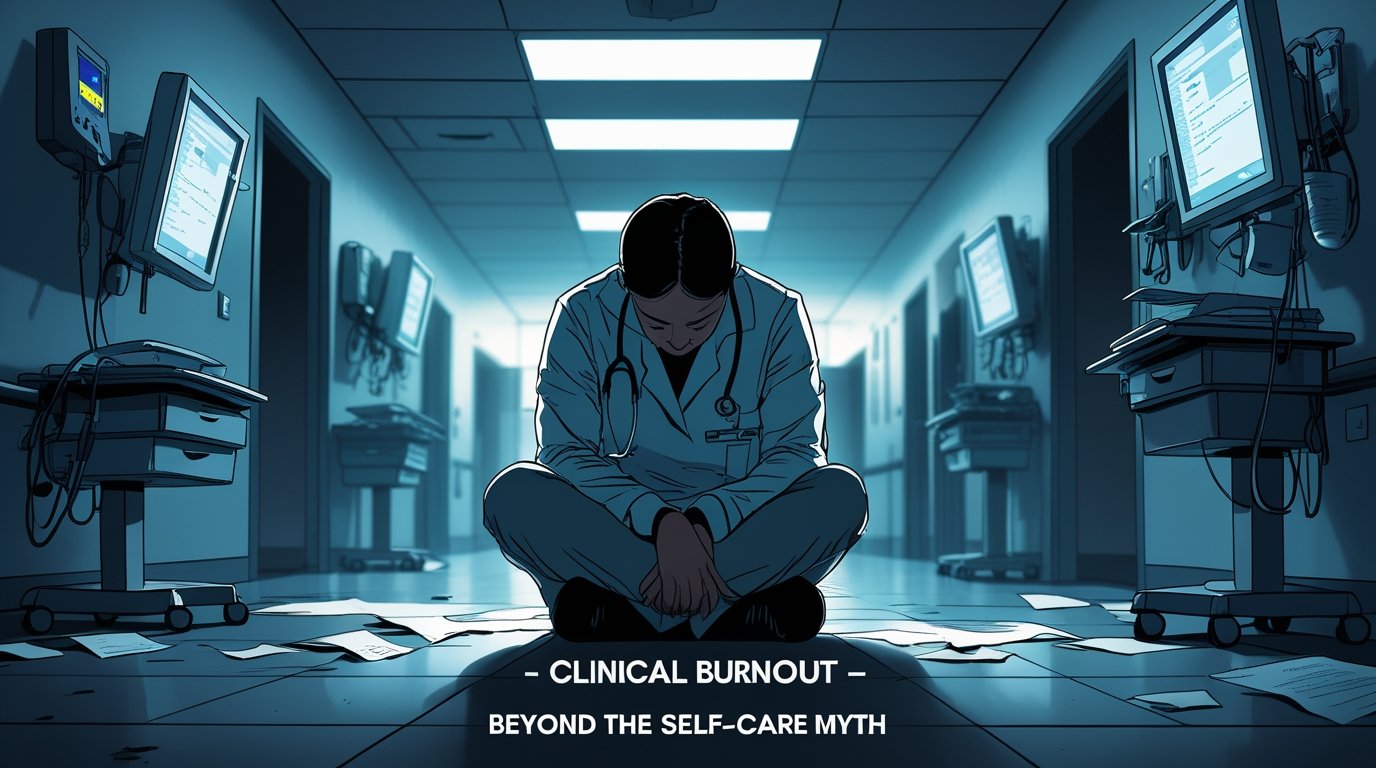
I once attended a mandatory hospital seminar on “Burnout Prevention” where they handed out lukewarm herbal tea and a pamphlet on “Mindful Breathing” while my pager was screaming like a banshee in my pocket. I was three hours late for dinner, I hadn’t seen my own family in daylight for four days, and I was being told that the solution to my soul-crushing exhaustion was a scented candle and a “positive attitude.” It was like trying to put out a forest fire with a water pistol filled with lavender essential oil. I realized then that the “Self-Care Myth” isn’t just annoying; it’s a form of gaslighting. It tells the clinician that the problem is their “resilience,” rather than a system that is fundamentally designed to consume human beings like fuel.
1. The Day I Realized “Yoga” Wasn’t Enough:
For months, I tried to “self-care” my way out of clinical burnout. I woke up at 5:00 AM to meditate, I drank enough green smoothies to turn my skin a faint shade of kale, and I practiced deep breathing until I was practically hyperventilating. I was the “Gold Standard” of self-care.
Yet, when I pulled into the hospital parking lot, my hands would shake. I would sit in my car for ten minutes, staring at the concrete, feeling a sense of dread so heavy it felt physical.
The problem wasn’t my personal habits. The problem was that I was returning every day to an environment of Moral Injury. I was being asked to care for forty patients when I only had the time to truly see ten. I was spending 60% of my day fighting with insurance companies and clunky EHR (Electronic Health Record) software rather than actually practicing medicine. Burnout isn’t a “lack of relaxation”; it is the erosion of the soul caused by a disconnect between your values and your daily reality. No amount of downward dog can fix a broken infrastructure.
2. Burnout vs. Moral Injury: Shifting the Language:
We need to stop calling it “Burnout” and start calling it what it often is: Moral Injury.
The term “Burnout” implies that I am a battery that just ran out of juice. If I “recharge” on vacation, I should be fine, right? But “Moral Injury” is different. It’s the psychological distress that results from actions, or the lack of them, that violate your moral or ethical code.
In my practice, the “injury” came from the systemic constraints that prevented me from giving my patients the care they deserved.
- It was knowing a patient needed a specific treatment but being forced to deny it because of “Protocol.”
- It was having to rush through a terminal diagnosis conversation because I was “behind schedule.”
- It was the “Death by a Thousand Clicks” that turned my patients into data points.
When I shifted my language from “I’m burned out” to “I am morally injured by this system,” the shame vanished. I wasn’t “weak.” I was a person with a conscience reacting to a dysfunctional environment. This distinction is the first step toward actual healing.
3. The “Efficiency” Trap: Why We Can’t Breathe:
The modern clinical environment is obsessed with Throughput. We are treated like assembly-line workers in a factory of “Wellness.”
I remember a specific administrator telling me that if I could shave just 90 seconds off every patient encounter, I could see two more patients a day. In the world of spreadsheets, that’s “Efficiency.” In the world of clinical care, that’s the death of the relationship.
Those 90 seconds are where the “Medicine” happens. It’s the moment the patient finally feels safe enough to tell you about the lump they found, or the grief that’s keeping them awake. When we optimize for speed, we dehumanize the process. I started prioritizing my own sanity by refusing the “Efficiency” metric. I realized that if I worked at the pace the system demanded, I would eventually stop caring altogether. And a clinician who doesn’t care is the most dangerous person in the room.
4. The Myth of the “Resilient” Clinician:
There is a dangerous trope in our industry: The “Super-Doc” or the “Angel Nurse” who can handle anything without breaking. We are taught that “Resilience” means being an indestructible brick wall.
I’ve learned that true resilience isn’t about being unbreakable; it’s about being Flexible and Honest. The “Strong” people I knew were the ones who crashed the hardest because they never allowed themselves to say, “I am overwhelmed.” They viewed a need for help as a professional failure.
I started fighting the “Self-Care Myth” by being radically honest with my colleagues. I started saying, “This shift was brutal, and I’m not okay.” When we stop pretending to be superhuman, we create space for actual support. Resilience shouldn’t be a “Solo Sport.” It should be a “Team Effort” where we look out for each other’s humanity, not just each other’s “Productivity.”
5. Systemic Solutions: What “Real” Care Looks Like:
If scented candles aren’t the answer, what is? After my own burnout-induced “Great Awakening,” I started advocating for Systemic Interventions.
Real care for clinicians looks like:
- Scribe Support: Removing the 4 hours of data entry that follow an 8-hour shift.
- Protected Time: Ensuring that “Administrative Tasks” have their own block of time that isn’t stolen from lunch or sleep.
- Meaningful Autonomy: Giving providers the power to make clinical decisions without a bureaucratic “Permission Slip.”
- Rational Staffing: Moving away from “Lean” staffing models that leave no room for human error or fatigue.
I stopped asking for “Wellness Rooms” and started asking for “Process Improvements.” I realized that a well-designed workflow is more “Healing” than any meditation app. If you want to help a drowning person, don’t give them a breathing exercise, pull them out of the water.
6. The “Second Victim” Phenomenon:
One of the deepest roots of clinical burnout is the Fear of Error. In our culture, a medical error is treated as a personal moral failure rather than a systemic glitch.
When something goes wrong, the clinician becomes the “Second Victim.” We carry the guilt, the shame, and the “What-Ifs” for years. In my case, a minor medication error (that thankfully didn’t harm the patient) haunted me for months. I didn’t need “Self-Care”; I needed a Just Culture.
A “Just Culture” recognizes that humans make mistakes and looks at the system that allowed the mistake to happen. When I worked in an environment that prioritized “Learning” over “Blaming,” my burnout levels plummeted. The constant, low-level anxiety of being “Perfect” is a weight no human can carry indefinitely.
7. Reclaiming the “Why”: The Only Real Antidote:
The only thing that ever truly “recharged” me wasn’t a day at the spa; it was a meaningful connection with a patient.
Burnout happens when the “Drudgery” (paperwork, politics, billing) outweighs the “Meaning” (healing, connection, service). I started a practice I call “Meaning Mining.” Every day, I force myself to find one moment where I actually made a difference. I write it down.
When the pile of “Meaningless” tasks gets too high, I look at that list. It reminds me that I am not a “Data Entry Clerk with a Stethoscope.” I am a healer. However, the system makes this “Meaning” harder and harder to find. If you have to dig through six feet of bureaucratic sludge to find one moment of joy, you will eventually stop digging. That’s why we must fight for the “Right to Care.”
8. The Boundaries of the “Vocation.”:
We are told that medicine is a “Calling,” and therefore, we should be willing to sacrifice everything for it. This is a trap.
A “Calling” shouldn’t be a “Suicide Pact.” I had to learn the hard way to set Rigid Boundaries.
- I stopped checking emails at home.
- I stopped saying “Yes” to every extra committee or weekend shift.
- I started treating my time with my family as a “Non-Negotiable Medical Appointment.”
When I treated my work as a “Highly Skilled Profession” rather than an “All-Consuming Identity,” the burnout began to lift. I became a better clinician because I was a more “Complete” human being. You cannot pour from an empty cup, no matter how “Called” you feel to do so.
The Bottom Line:
I’m done with the herbal tea and the “Mindfulness” posters. Clinical burnout isn’t a “Personal Problem” that can be fixed with a better morning routine; it is a “Systemic Crisis” that requires a total re-evaluation of how we value human labor in healthcare. We don’t need more “Resilience Training”; we need a system that doesn’t try to break us in the first place. If you are feeling the “Burn,” know that it isn’t because you aren’t “strong enough.” It’s because you are a human being in a machine that has forgotten what humanity looks like. It’s time to stop fixing the “Self” and start fixing the “System.”
FAQs:
1. Is burnout just “Stress”?
No. Stress is about “Too Much”—too many tasks, too much pressure. Burnout is about “Not Enough”—not enough meaning, not enough hope, not enough care.
2. Why does the system push “Self-Care” so hard?
Because it’s cheaper and easier to tell you to “Meditate” than it is to hire more staff or fix the software. It shifts the burden of the problem from the Organization to the Individual.
3. Can I recover from burnout without quitting my job?
Sometimes, but it requires “Radical Systemic Changes” in how you work and a willingness to set boundaries that might make you “Less Productive” in the eyes of the system.
4. What is the first step toward recovery?
Acknowledge that you aren’t the problem. Stop blaming your “Lack of Resilience” and start looking at the “Moral Injury” of your environment.
5. How can leadership help?
By listening to the frontline staff and removing the “Friction” in their day. Ask: “What is the most annoying thing you have to do today?”—then fix that.
6. Does everyone in healthcare get burned out?
Recent data suggests up to 50-60% of clinicians experience symptoms. It is an epidemic, not an individual failing.
