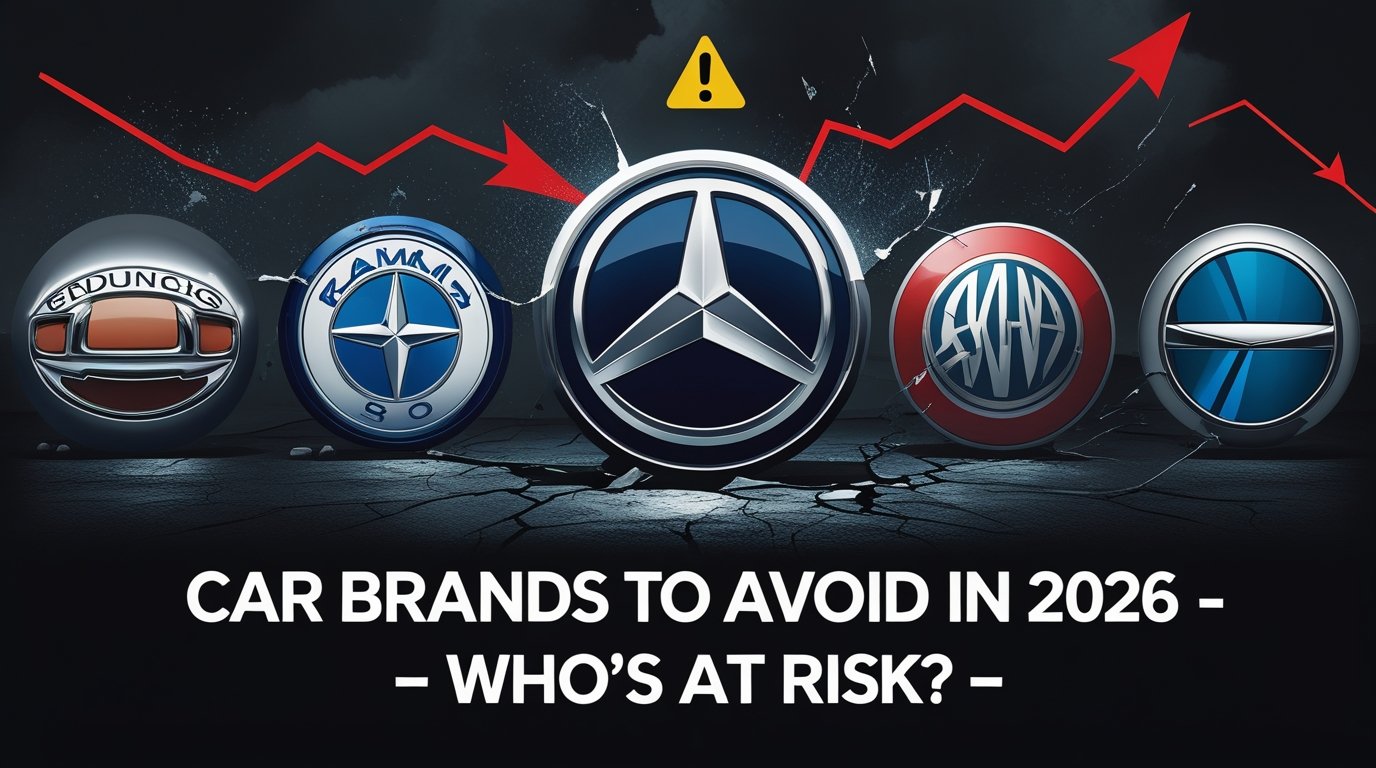
Imagine finding out that the automaker behind your car is collapsing and neither the brand nor your dealer ever told you a thing. Sales are drying up, dealerships are struggling, model lineups are shrinking, and owners are left stranded with cars that plummet in value. Today, we’re counting down the six car brands that are on the brink of collapse. Whether it’s because of infamous scandals, disastrous corporate decisions, or simply getting crushed by the competition. And here’s the most shocking part. The number one brand on this list continues to sell strongly despite being in a deep crisis. Stay until the end because what I’m about to reveal is something dealers don’t want you to know. So, let’s get going.
The Luxury Brand That Couldn’t Buy Status:
Let’s start with a Korean luxury brand that was expected to take on BMW and Mercedes, but became a cautionary tale instead. Yes, coming in at number six is Genesis, the luxury division of the Hyundai group that was created to compete with the giants of the luxury market. The promise was simple. German-level luxury without the German price tag. Impressive styling, advanced tech, premium interiors, all priced lower than the competition. On paper, the idea sounded perfect. It was supposed to be affordable luxury.
But here’s the problem. Luxury buyers aren’t looking for bargains. They care about status. And that’s where Genesis fell short. Many still see it as a Hyundai disguised in an expensive suit. The sales numbers may look good at a glance. Almost 75,000 units were sold last year in the United States, but that figure pales in comparison to BMW’s 371,000 units, Lexus’s 346,000 units, or Mercedes’s 324,000 units. A new logo or a redesigned grill isn’t enough to attract luxury buyers.
Genesis still struggles for brand identity and recognition, both of which are key for a luxury brand. The ownership experience was nothing like what was promised. Luxury buyers expect a premium experience, but in practice, many of its cars were sold on Hyundai lots. And then came the reliability issues.
In 2022, Genesis recalled Multiple models for fuel pump failures that caused the vehicle to abruptly stall, and their EVs, like the G80 and GV60, were recalled for power loss issues last year. This kind of thing destroys customer trust. The tariffs didn’t help either, as many models rely on imported parts, which drove prices up. their EV hope. The new GV60 is already losing ground. The electric G80 has already been axed from the lineup, and reports suggest the G70 and electric GV70 might be discontinued later.
If things go on like this, Genesis risks fading from the market, leaving owners stuck with vehicles that plummet in value. So, if you’re thinking about buying a Genesis right now, think twice.
How a Rebrand Killed a Gentleman’s Legacy:
But if you think this brand is struggling, the next one shows how a single rebrand can destroy decades of prestige overnight. You guessed it right. At number five, we have Jaguar. There was a time when owning a Jaguar wasn’t just buying a car. It was a buying status. Jaguar was the true gentleman’s badge. Known for its stylish design, elegant sedans, and roaring sports cars, it was the symbol of British luxury.
However, today Jaguar is just a shadow of what it once was, and that’s an understatement. The F-Pace SUV is the only remaining model in their lineup, as the brand pulled the plug on several models like the XE, XF, F-Type, Ipace, and E-PACE in 2024 across various markets, including the US. The company risked everything for a dramatic pivot to all-electric luxury, which created a product vacuum. Dealers are left with nothing to offer.
Sales have been plummeting over the years, and recent sales figures are so low that it’s statistically irrelevant. The rebrand was absolutely disastrous. The iconic Leaping Cat logo was replaced by something that many criticized as generic corporate slop. Their infamous rebrand ad crushed decades of brand image and legacy overnight. The reactions were brutal, and their CEO stepped down months later. Several dealerships are closing, and JLR is now kept alive almost entirely by Land Rover, which continues to sell strongly.
Jaguars were never known for reliability, either. Repair Pal gives Jaguar 2.5 out of five stars for reliability, which puts them 29th out of 32 car brands. The recent events have destroyed customer confidence. And it’s no surprise resale values are tanking. Unless their new EVs perform miracles when they arrive, Jaguar risks fading into extinction.
Jaguar didn’t die because it was outdated. It died because it abandoned what made it special. If you were planning to buy one of their models, whether it’s new or used, seriously reconsider your decision.
From Rally Icon to Forgotten Brand:
If you think that was bad, wait. The next brand on the list was a Japanese cultural icon in the 2000s. Coming in at number four is a brand that once dominated world rallies and the streets. It gave us iconic models like the Lancer Evolution and Montero. Yes, I’m talking about Mitsubishi, a brand that once stood for affordable performance, off-road capability, and bulletproof reliability. That brand is now struggling to survive.
In 2002, Mitsubishi sold almost 345,000 units in the US. But 20 years later, that figure fell to just 86,000 units, a steep decline in volume. And 2025 made things even worse. The new US tariffs stalled deliveries and left thousands of units stranded at ports. Mitsubishi had no choice but to hike prices. A huge blow for a brand that relied on budget-conscious buyers. Mitsubishi’s lineup today is nothing like it was before. What remains is a thin list of SUVs and crossovers. Their products are outdated, and the competition outperforms them on all fronts.
Although Mitsubishi is generally known for reliability, the ownership story hasn’t been exactly trouble-free. Many owners report CVT transmission failures, suspension problems, engine stalling, and electrical faults. And if you think Mitsubishi’s problems end there, that’s only half the picture. Mitsubishi has been losing credibility and reputation for years.
Back in 2000, the brand was caught covering up serious mechanical defects, a scandal that destroyed public trust. Again, in 2016, the brand was caught falsifying fuel consumption data for over 625,000 vehicles. The fallout was brutal. Executive resignations, police raids, lawsuits, and market value fell by half. The collapse was so severe that Nissan had to step in and buy a controlling stake just to keep Mitsubishi alive.
Today, Mitsubishi is a brand that lost its identity and has no clear vision. The badge still has a legacy, but the cars today don’t live up to it. It’s no surprise that their models lose value fast. So, if you’re considering buying a Mitsubishi right now, think carefully.
The “Driver’s Luxury” Brand That Lost Its Way:
The next brand on this list was called Drivers Luxury. And no, I’m not talking about BMW. Number three belongs to Infiniti. At one point, Infiniti looked like Japan’s next big success story and Nissan’s answer to Lexus. Their models appealed to luxury buyers who wanted BMW-like performance and handling with Japanese reliability. Their V6 and V8 engines were as powerful as they were durable. Cars like the G35, the FX series, and the QX80 shaped an era. Infiniti wasn’t just a cheaper luxury brand. It had an identity, attitude, and a loyal following.
However, today, they are a brand running on borrowed time. In 2017, Infiniti sold 153,000 vehicles in the United States. By 2024, that figure fell to just 58,000 units, a 10% drop from the previous year. In response to the slumping sales, the brand was forced to shut down standalone showrooms and retreat into Nissan dealerships as part of a consolidation plan.
Models are disappearing, too. Production of the QX50 and QX55 ended in 2025, and the Q50, their last sedan, is already gone. What remains is a thin lineup of two SUVs, the QX60 and the QX80. The decline began in the mid-2000s when Infiniti tried to reinvent itself instead of improving what already worked. The brand abandoned its performance roots and shifted to generic luxury crossovers.
Although generally considered to be reliable, their vehicles have had their own set of issues, too. Problems with the CVT transmission haunted older models. Tens of thousands of vehicles were recalled for different issues like engine failure, power loss, airbag defects, and faulty brake calipers. These shattered buyer confidence, and resale values tanked as a result. Infiniti hopes to rebound with upcoming models and a future EV lineup, but whether that will be enough remains to be seen.
In the meantime, owners are left with vehicles that are rapidly losing value and a dealer network that continues to shrink. So, if you’re planning to buy a car for the long term, Infiniti shouldn’t be near the top of your list. The cars themselves aren’t bad, but buying into a brand that’s losing ground is a risky bet.
The American Innovator Facing Extinction:
If you think this collapse only happens to foreign manufacturers, think again. The next name on this list was once the pride of American automotive engineering. At number two, we have Chrysler. A brand that was once the favorite for millions of families across America. For decades, Chrysler represented innovation, comfort, and practical family vehicles that didn’t break the wallet. The first production Hemi V8 was introduced to the roads by Chrysler. They invented the minivan, a segment that changed American family vehicles forever. Chrysler wasn’t just a car brand. It was a part of American culture. The badge used to be synonymous with respect and prestige.
Back in 2005, the brand sold more than 640,000 vehicles in the United States. However, by 2024, that number collapsed to under 125,000 units, a staggering 80% decline from its peak. And 2026 is set to be even worse. Sales are on track to hit their lowest levels. While its competitors modernize their lineups, Chrysler kept aging platforms and refreshing the same models for years. The Chrysler 300, one of the last models that represented the brand’s identity, was discontinued in 2023, closing the chapter on its most iconic sedan.
The Voyager has survived mostly as a fleet-only model. Though it recently made a return to the consumer market, the Pacifica, the only true consumer model keeping the brand alive, is losing ground fast. Rivals like the Honda Odyssey, Kia Carnival, and Toyota Sienna offer better tech, more reliability, and lower depreciation.
It’s no surprise that Pacifica sales fell by 11% in 2024. The dealership’s collapse made things even worse. The Airflow EV was supposed to be Chrysler’s chance for a comeback, but Stellantis canceled the project mid-development as it was too expensive and already outdated.
Today, Chrysler is a brand with an uncertain future. And that’s not just speculation. Carlos Tavarez, the former CEO of Stellantis, warned last year that several of the group’s brands could disappear by 2026. And Chrysler likely is one of them. It’s the owners who take the biggest hit. Stuck with vehicles that plummet in value, limited technical service, and less availability of spare parts.
Buying a Chrysler today comes with a very real risk of ending up with a vehicle abandoned by its own manufacturer.
The Global Giant in Silent Crisis:
If you thought that was bad enough, the next brand proves that even the giants of the auto industry are not safe. The brand that takes the number one spot on this list is Nissan. A choice that will surprise a lot of people, and for good reason. For decades, Nissan was a global powerhouse that stood for engineering excellence, innovation, bulletproof reliability, and affordable performance. Their vehicles defined generations and ruled the roads across continents. They gave us some of the most iconic nameplates like the GTR, Armada, Ultima, and Frontier. Nissan was a badge that commanded respect worldwide.
However, today the brand is in danger of collapse. Yes, you heard that right. In 2024, Nissan sold over 865,000 vehicles in the United States. That may look solid, but on the inside, the company is in total crisis. The Maxima, their flagship sedan, was axed in 2023 as sales collapsed. The Ultima is also following the same path. Globally, Nissan reported a loss of $4.5 billion, with operating profits down 90% in a year.
Sales worldwide went down from 5.8 million units in 2017 to just 3.3 million units in 2024, and Nissan had to undertake drastic measures to address that. The automaker laid off nearly 20,000 employees, slashed production, and shut down several manufacturing plants.
Recently, Nissan pulled the plug on the Aria EV and cancelled two upcoming EV projects for the US market, leaving them with no real future in the electric segment.
A brand that once stood for innovation now has no strategy. Nissan’s downfall didn’t happen overnight. The cracks started years ago. In 2018, CEO Carlos Ghosn was arrested for hiding millions and using company assets for personal gain. That led to a major corporate crisis for Nissan, eroding trust from its partners. On top of that, multiple emissions and fuel economy scandals shattered the public trust and destroyed the reputation.
In 2024, Nissan attempted a failed merger with Honda, but talks fell apart when Honda demanded total control. Since then, Nissan has been desperately searching for alliances, but nothing has been signed. Internal sources suggested the company has only 12 to 14 months left to survive before finding a major investor.
Let’s hope Nissan makes a comeback, but things are very difficult for them now. Buying a Nissan right now is a risk in the long run. Because when an automaker is fighting for survival, it’s not the company that pays the price first, it’s the owners.
Conclusion:
This list reveals that a car brand’s collapse isn’t always loud; sometimes, it’s a silent crisis hidden behind decent sales figures or a famous badge. Whether it’s losing its identity, betting on the wrong future, or being ravaged by scandal, each brand’s story serves as a stark warning: buying a car is a long-term commitment, and the greatest financial risk isn’t the mileage, it’s the manufacturer disappearing from the road entirely.
FAQs:
1. Why is Genesis struggling as a luxury brand?
A: Luxury buyers prioritize status over bargains, and many still see Genesis as a fancy Hyundai, lacking the brand prestige and recognition of its German rivals.
2. What single move crippled Jaguar’s reputation?
A: A disastrous, widely mocked rebrand that replaced its iconic “Leaping Cat” logo with generic “corporate slop,” crushing decades of legacy overnight and alienating its core buyers.
3. What killed Mitsubishi’s reputation in the 2000s?
A: A massive scandal where the company was caught systematically covering up serious vehicle defects for decades, destroying public trust that it never fully regained.
4. How did Infiniti lose its “driver’s luxury” identity?
A: It abandoned its performance roots and distinctive models in the mid-2000s, shifting to generic luxury crossovers that blurred its line with competitors and diluted its loyal following.
5. What is the biggest risk of buying a Chrysler today?
A: The very real possibility that the brand could be discontinued by its parent company, Stellantis, leaving owners with a vehicle abandoned by its manufacturer and plummeting in value.
6. If Nissan’s US sales are strong, why is it in crisis?
A: The company is bleeding money globally ($4.5B loss), has slashed production and EV plans, and internal reports suggest it has only 12-14 months to find a major investor or partner to survive.