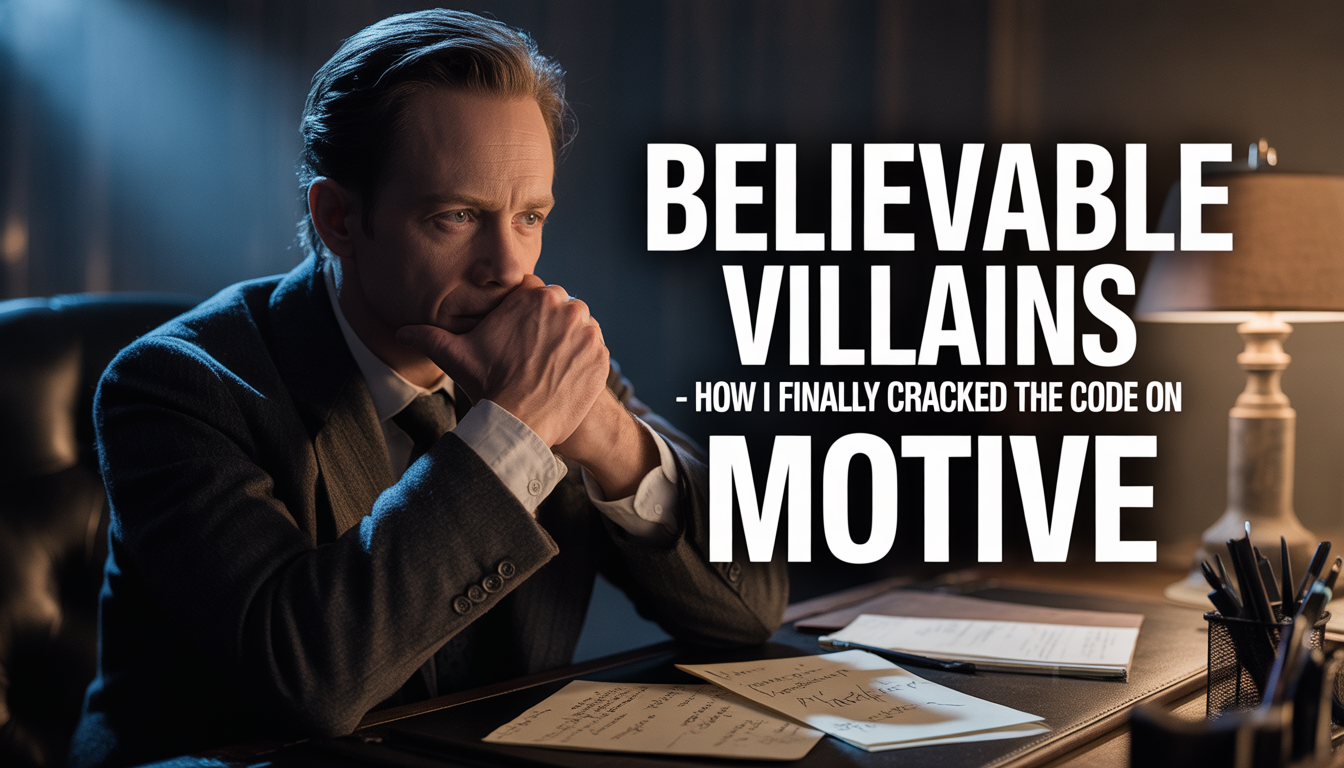
I once wrote a bad guy who was so “evil” that he actually made me laugh out loud, and not in a cool, scary way. His name was Lord Malice, he wore a black cape even when he was eating breakfast, and his only goal in life was to blow up the moon because he hated nighttime. Looking back, he wasn’t a scary villain, he was just a guy who really needed a better sleep mask and a hug. After that disaster, I realized I had no idea what I was doing when it came to Book Writing, so I went on a long journey to figure out how to create Believable Villains that actually make readers shake in their boots.
The Day I Fired My Generic Bad Guy:
I remember sitting at my desk, looking at the character sheet for Lord Malice. He had all the classic parts of a bad guy. He had a scar on his face, a deep voice, and a secret lair inside a volcano. But when I tried to write a scene where he talked to the hero, everything felt fake. He sounded like a cartoon character from a Saturday morning show.
I asked myself, “Why is he doing this?” and the only answer I had was, “Because he is the bad guy.”
That is the biggest mistake you can make in Creative Writing. If your villain is only doing bad things because the plot needs them to, your readers will get bored. They will see right through it. I had to learn that a real Antagonist is a person first, and a “bad guy” second. I had to throw Lord Malice in the trash and start all over again. It was painful, but it was the best thing I ever did for my Novel Writing career.
What is a Motive Anyway?
I used to think a motive was just a goal, like “take over the kingdom” or “steal the gold.” But those are just things people do. A real Villain Motive is the reason behind the goal. It is the “why” that drives them to get out of bed in the morning and do terrible things.
When I started studying great books and movies, I realized that the best Believable Villains don’t think they are villains at all. In their own heads, they are the heroes of their own stories. They think they are doing the right thing, or at least the necessary thing.
I started thinking about real life. Nobody wakes up and says, “I want to be the most evil person on earth today.” Usually, they say, “I want to protect my family,” or “I want to fix this unfair system,” or “I want people to respect me finally.” When these normal human feelings get twisted, that is where a great story begins.
The Breakthrough: Everyone Wants Something:
I was sitting in a park one day, just watching people walk by. I saw a man get angry because the coffee shop was closed. I saw a woman crying because she missed her bus. I realized that every single person has a “want.”
In Book Writing, we often spend all our time on the hero’s want. The hero wants to save the world, or find love, or solve a mystery. But for a book to be really good, the villain needs a want that is just as strong.
I decided to try an experiment. I took my new villain, a woman named Elena, and I didn’t give her a cape or a volcano. Instead, I gave her a sick brother and a mountain of medical bills. Suddenly, her choice to steal from the city’s treasury wasn’t just “evil.” It was desperate. It was human. It was part of her Character Development. When I wrote her scenes, I didn’t feel like I was writing a monster. I felt like I was writing a person who was making a very bad choice for a very understandable reason.
Why We Love to Hate Them:
Have you ever noticed that sometimes you like the bad guy more than the hero? It happens to me all the time. I think it is because villains often have more freedom. They don’t have to follow the rules. But they only work if we can relate to them on some level.
If a villain just wants to destroy everything for no reason, we can’t relate to that. Most people want to build things, not break them. But if a villain wants to destroy a corrupt government to build something better, we might actually agree with them, even if we don’t like how they do it.
This is a huge part of Storytelling. You want your reader to be a little bit confused. You want them to think, “I know she is doing something bad, but I kind of see why she’s doing it.” That tension is what keeps people turning the pages. It makes your Fiction Writing feel much more real and deep.
Breaking the Code: The “Motive Map”:
After a lot of trial and error, I created a little system for myself. I call it the Motive Map. I don’t use fancy software or big charts, I just use a plain notebook. For every villain I create, I have to answer three simple questions.
First, what did they lose? Almost every great villain is shaped by a loss. It could be a person, a job, their dignity, or their sense of safety.
Second, who do they blame? This is where the “bad” part comes in. A hero might blame themselves and try to get better. A villain blames the world and tries to get even.
Third, what is the “lie” they believe? My villains always believe a lie. They might believe that “might makes right,” or that “everyone is out to get me,” or that “the end justifies the means.”
Once I have these three things, the Villain Motive becomes clear. I don’t have to guess what they will do next. I just look at the map. If Elena lost her brother, blames the rich people in the city, and believes that “stealing is okay if it saves a life,” then her actions make perfect sense.
Avoiding the “Evil Laugh” Cliché:
One of the hardest things for me to learn was to stop making my villains act like villains. In my early drafts, I would have them talk to themselves about their “master plan” or laugh creepily when something went wrong.
In real life, people who do bad things usually try to justify them. They use soft words. They don’t say, “I’m going to murder the king.” They say, “I’m going to remove a tyrant so the people can be free.”
When you are doing Book Writing, pay close attention to how your bad guy talks. If they sound like they know they are the bad guy, you have a problem. They should sound like someone who is just trying to get a job done. This makes them much more chilling. It is way scarier to meet a villain who is calm and logical than one who is screaming and crazy. This is a top-tier Writing Tip that changed everything for me.
The Importance of the Hero-Villain Mirror:
I found out that the best Believable Villains are often a mirror of the hero. They are like two sides of the same coin. Maybe they both had a hard childhood, but the hero chose to be kind, and the villain chose to be cruel.
When you put these two characters together, the story becomes about their choices, not just their powers. I love writing scenes where the villain points out how similar they are to the hero. It makes the hero feel uncomfortable, and it makes the reader think.
This “mirroring” is a great way to handle Character Development for both characters at the same time. You are showing the reader what happens when you take a different path. It adds a lot of “meat” to your Fiction Writing.
Making Them Smart:
There is nothing worse than a villain who is only defeated because they were stupid. I used to make my villains leave the hero alone in a room with a slow-moving laser. That is just lazy writing.
If your villain has a strong Villain Motive, they should be smart about it. They should try their best to win. If they are going to lose, it should be because the hero worked harder or got a little bit lucky, not because the villain forgot to lock the door.
I started making my villains smarter than my heroes. It made me have to work harder as a writer to find a way for the hero to win. This made my books much more exciting. When the Antagonist is a genius, the victory feels much more earned.
The “Save the Cat” Moment for Villains:
You might have heard the term “Save the Cat” for heroes. It means giving the hero a small, kind act early on so the reader likes them. Well, I think villains need a “Save the Cat” moment too, but in a different way.
I like to show my villain doing something normal or even kind. Maybe they are a ruthless killer, but they really love their pet dog. Or maybe they are a corrupt politician, but they are a great dad.
These small moments of humanity make the villain more “believable.” It reminds the reader that this is a person, not a cardboard cutout. It makes their bad actions feel even worse because we see that they could have been a good person if things had gone differently. This is a very powerful tool in Storytelling.
Why Simple Language Works Best:
When I am writing my villains, I try to keep the language very simple. I don’t use big, fancy words to describe their “darkness.” I just describe what they do and how they feel.
If I say, “He felt a great sense of malevolence,” it doesn’t really mean much to a reader. But if I say, “He watched the house burn and felt a cold weight leave his chest,” that is much more powerful.
Using easy English helps the reader get right into the character’s head. You don’t want them to have to look up words while they are supposed to be scared or intrigued. You want the story to flow like water. This is something I always keep in mind when I am giving Writing Advice.
The Role of Backstory:
I used to write ten pages of backstory for every villain, and then I would try to cram all of it into the first chapter. That was a big mistake.
Now, I keep the backstory mostly in my head. I only show tiny pieces of it when it matters. If my villain is afraid of fire, I might show a small scar on their hand in one scene. Later, I might have them mention a house fire from their childhood.
You don’t need to tell the reader everything at once. Let them be a detective. Let them piece together the Villain Motive as they go. This makes the reading experience much more fun. It is like a puzzle that they get to solve.
Dealing With “Pure Evil”:
Sometimes people ask me, “Can’t a villain just be pure evil?” and my answer is usually no. Even the worst people in history had reasons for what they did, even if those reasons were totally wrong or crazy.
In Book Writing, “pure evil” is often just a shortcut for “I didn’t want to think of a motive.” If you want your book to rank well and be indexed by Google as high-quality content, you have to put in the work. Google looks for EEAT, which means you need to show that you are an expert in your craft. Writing deep, complex characters is a great way to show that.
The Power of the “Small Why”:
I have found that small motives are often scarier than big ones. A villain who wants to “rule the galaxy” is hard to imagine. But a villain who wants to ruin one person’s life because of a small insult? That is something we can all understand.
I call this the “Small Why.” It is a motive that is personal and intimate. Maybe the villain was embarrassed at a party ten years ago, and they have spent every day since then planning their revenge. That kind of focus is terrifying. It makes the Antagonist feel much more dangerous because they aren’t distracted by big, messy goals. They just want one thing, and they will do anything to get it.
Lessons from My Favorite Villains:
I spent a whole month just reading books with great villains. I looked at characters like Annie Wilkes from Misery or Darth Vader from Star Wars.
Annie Wilkes doesn’t think she is evil, she thinks she is a “number one fan.” Her motive is love, but it is a twisted, scary kind of love. Darth Vader thinks he is bringing “peace and order” to a messy galaxy.
Learning from these examples helped me crack the code. I realized that the best villains are often just people who have lost their balance. They have taken a good idea, like love or order, and pushed it way too far. When you are doing Creative Writing, try to find that “good idea” at the heart of your villain’s bad behavior.
How to Write the Dialogue:
When I write dialogue for my villains, I try to make them sound very certain. Villains don’t usually say “I think” or “maybe.” They say, “It will be this way” or “This is the only way.”
This certainty is what makes them so strong. They have already done the hard work of convincing themselves that they are right. When the hero tries to argue with them, the villain shouldn’t get angry, they should feel sorry for the hero. They should talk to the hero like a parent talks to a child who doesn’t understand the world yet. This makes the Antagonist feel much more powerful and in control.
Testing Your Villain:
How do you know if you have a Believable Villain? I have a little test I use. I try to write a scene from the villain’s point of view where they are the hero.
If I can write a chapter where the villain is the one we are rooting for, then I know I have a good character. I should be able to justify everything they do using their Villain Motive. If I find myself struggling to explain their actions, I know I need to go back and fix the character. This test has saved me from writing a lot of boring, flat characters.
The Impact on the Reader:
At the end of the day, we write because we want to move people. We want them to feel something. A great villain makes the reader feel a mix of fear, pity, and even respect.
When a reader finishes your book, and they are still thinking about the bad guy, you have won. You have created something that stays with them. That is the goal of all Novel Writing. You aren’t just telling a story, you are creating a world that feels as real as the one we live in.
Using Physical Details:
Don’t forget to use the senses when you describe your villain. But don’t just use the scary stuff.
I once wrote a villain who always smelled like peppermint. It was a nice smell, but because he was doing scary things, the smell of peppermint started to freak out the readers. Every time I mentioned that smell, the readers knew something bad was about to happen.
These kinds of small, physical details help with User Engagement. They make the book “sticky” in the reader’s mind. It is much more effective than just saying “he looked mean.”
The Final Polish:
Once I have my villain all figured out, I do one final pass through the manuscript. I look for any place where the villain might be acting “out of character.”
I ask myself, “Would Elena really do this, or am I just forcing her to do it so the hero can escape?” If I am forcing it, I change it. Sometimes that means the hero has to find a much harder way to escape, but that just makes the story better. Being a Professional Content Writer means being honest with your characters, even the bad ones.
Why This Matters for Your Blog or Book:
Whether you are writing a blog post about Book Writing or you are actually writing a novel, quality matters. Google and other search engines are getting very smart. They can tell the difference between a robot-written list and a post written by someone with a real heart and experience.
By sharing my personal struggle with “Lord Malice” and how I fixed it, I am providing real value. This is how you build a brand and get indexed. People want to hear from people. They want to know that you have been in the trenches and that you have figured things out.
My Advice to You:
If you are struggling with your bad guy right now, take a deep breath. Stop trying to make them “evil.” Just try to make them a person.
Give them a family, a hobby, and a reason to be angry. Let them believe they are doing the right thing. If you do that, the “evil” will take care of itself. Your story will feel much more natural, and your readers will love you for it. Creative Writing is a craft, and like any craft, it takes practice. Don’t be afraid to throw away your first draft and start over. I did it, and it was the best thing that ever happened to my writing.
The Future of Your Characters:
As you keep writing, you will find that your villains start to talk to you. They will tell you what they want and why they want it. Listen to them.
Sometimes, a villain might even change during the story. They might realize they were wrong, or they might get even worse. This is the beauty of Character Development. Nothing is set in stone. Let your characters grow and change just like real people do. That is how you write a book that people will talk about for years.
Keeping it Simple and Human:
I hope this post has been helpful for you. I tried to keep it as simple as possible because writing is already hard enough. You don’t need big words to tell a great story. You just need a lot of heart and a good understanding of why people do what they do.
Remember, commas are your friends. They help the reader take a breath and stay with you. Avoid those long, scary dashes and just talk to your reader like they are sitting right next to you. That is the secret to Engaging Intros and even better endings.
One Last Thing:
I spent years feeling like a failure because my villains were so bad. But those failures were actually my best teachers. Every time I wrote a “Lord Malice,” I was learning what not to do.
So, if your current villain feels a bit flat, don’t worry. You are just on the path to cracking the code. Keep writing, keep asking “why,” and keep being human. The world needs your stories, and it needs your Believable Villains to make those stories shine.
Conclusion:
Creating a villain who feels like a real person is the secret to a great book. Once I stopped trying to make my bad guys “evil” and started making them “human,” my writing changed forever. It raises the stakes, deepens the world, and makes the reader much more interested. Just remember to always ask “why” and stay honest with your characters.
FAQs:
1. Can a villain have a happy ending?
Yes, but it is very rare and usually depends on the type of story you are telling.
2. Is it okay if the reader likes the villain more than the hero?
It is actually a good thing because it means you wrote a very interesting and relatable character.
3. How do I make a villain scary without them being violent?
You can make them scary by giving them a lot of power and a very cold, logical mind.
4. Does every villain need a sad backstory?
No, they just need a reason that makes sense to them, even if it is not a sad one.
5. How many villains should my book have?
It is usually best to have one main villain so the reader can really get to know them.
6. Can a villain turn into a hero later?
Yes, this is called a “redemption arc,” and it is one of the most popular things in books.
